What is Stand-Alone BeiDou?
Some MAKE1 product models support stand-alone BeiDou (stand-alone BDS). Stand-alone BeiDou devices feature a dedicated BeiDou positioning processor, which is a separate chip or chip set not integrated into other chips such as the main control processor or communication processor. This independent processor has BeiDou positioning capability, but depending on the model, it may be either BeiDou-only or BeiDou/GPS hybrid positioning.
Integrated GPS or integrated BeiDou means that the GPS positioning capability is embedded within the communication processor rather than being implemented on a separate chip.
What Are the Advantages of Stand-Alone BeiDou?
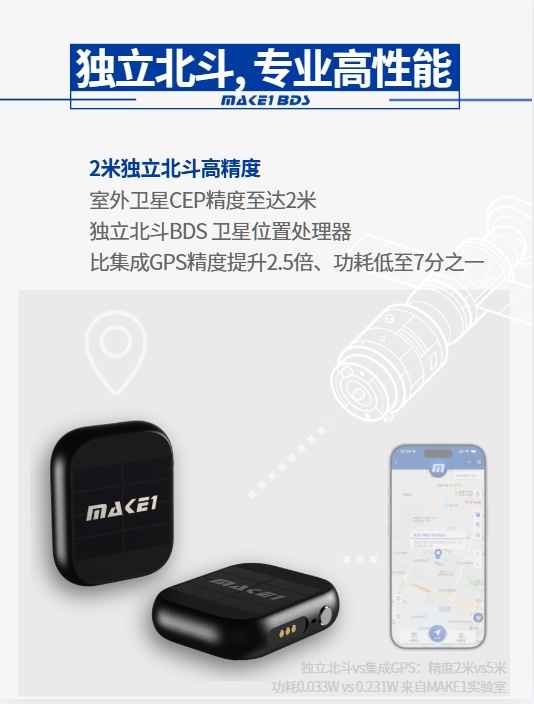
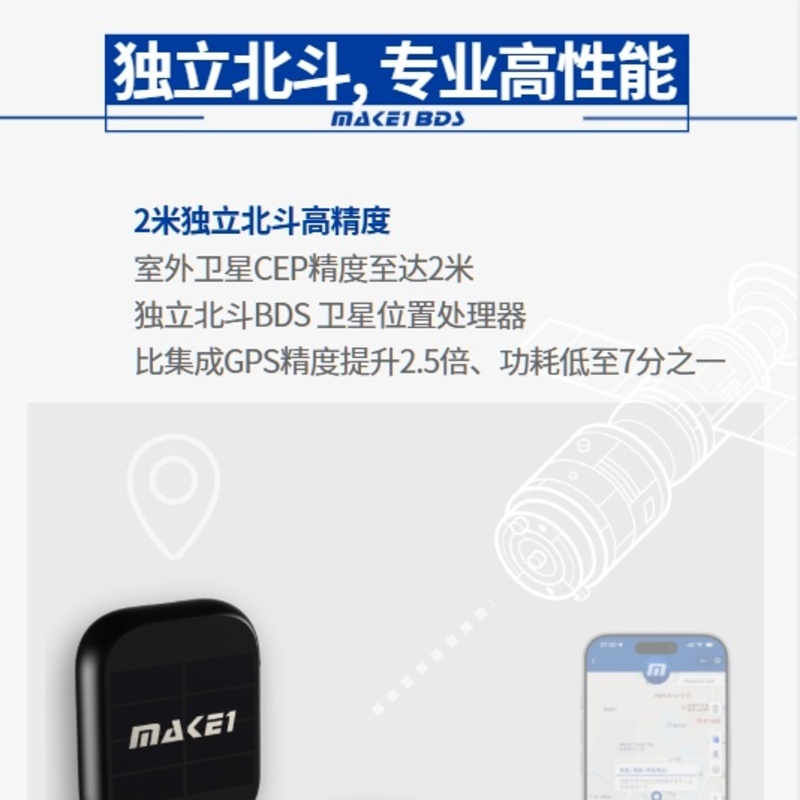
The greatest advantage of stand-alone BeiDou is extremely low power consumption and higher positioning accuracy. According to comparative tests conducted in the MAKE1 laboratory, the power consumption of stand-alone BeiDou satellite positioning is only 1/7th that of integrated GPS (33mW vs 231mW), while positioning accuracy is improved by 2.5 times (2 meters vs 5 meters CEP accuracy).
MAKE1 product models using stand-alone BeiDou offer longer battery life and more precise positioning capabilities.
Why Is Stand-Alone BeiDou Better Than Integrated GPS?
Lower power consumption: GPS integrated into the communication processor shares the same power domain, internal clock, and power LDO with the communication baseband. When the baseband remains powered or idle, additional leakage current occurs. Moreover, the data processing capacity of the communication processor far exceeds GNSS positioning requirements, yet it consumes significant power and cannot achieve independent power-down sleep. Typical Cat1 communication modules with built-in GNSS continuous positioning draw around 70–90mA. In contrast, stand-alone BeiDou processors avoid these issues. After optimization of IC process technology and GNSS signal processing algorithms, positioning power consumption can be reduced to as low as 10mA.
Higher positioning accuracy: Compared to GPS, BeiDou features higher orbital elevation angles, optimized ionospheric models, and dedicated optimizations for the B1C frequency band in domestically developed BeiDou chips. These factors contribute to better positioning accuracy than GPS. Without relying on RTK, BeiDou achieves 1.5–3 meters accuracy, whereas GPS typically ranges from 3–5 meters. Additionally, when the stand-alone BeiDou processor and communication processor are separated, and the GNSS antenna is physically isolated from the communication antenna, power and signal interference are reduced, further enhancing positioning accuracy.